
CMS CoP and Remote Verification: What Officers Miss
42 CFR 482.25 never mentions telepharmacy. Here is where remote medication verification actually creates CMS Conditions of Participation exposure.
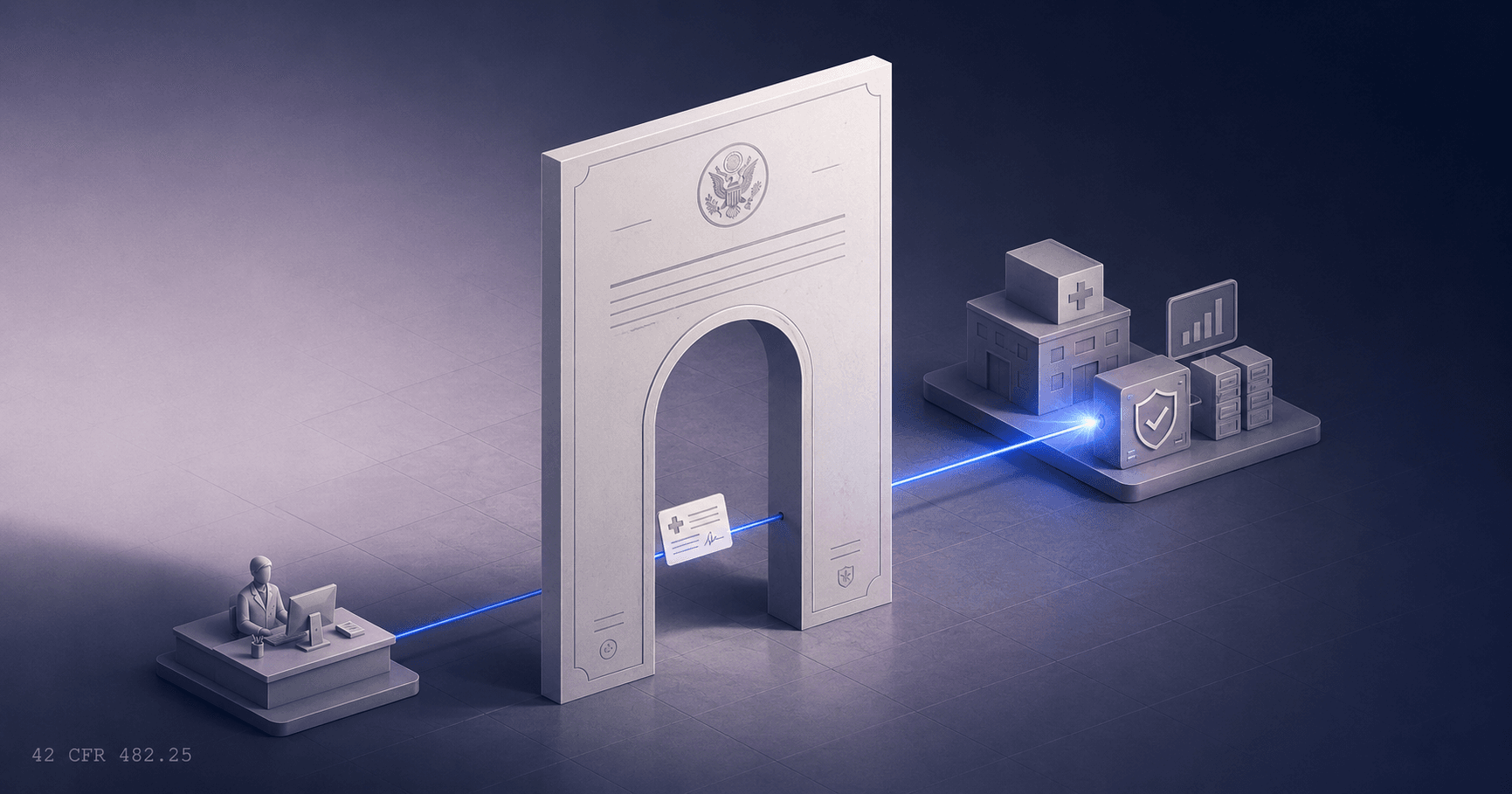
Open 42 CFR 482.25 and search for the word "telepharmacy." It isn't there. Neither is "remote," nor any line on where a verifying pharmacist has to physically sit. Compliance officers read that silence two ways, and both are wrong.
The first wrong reading treats silence as prohibition: if the Conditions of Participation don't authorize remote verification, it must be off-limits. The second treats silence as a free pass: the CoP doesn't address it, so there's nothing to survey. The regulation does neither. It attaches its requirements to the pharmaceutical function, not to a room.
The requirement follows the pharmacist, not the building
Section 482.25(b)(1) requires that all compounding, packaging, and dispensing of drugs be "under the supervision of a pharmacist and performed consistent with State and Federal laws" [CMS, 2012]. That clause does the real work. "Consistent with State law" pulls every state board of pharmacy telepharmacy rule into the federal CoP. A remote verification setup that violates your state board's rules is not just a state problem. At survey, it reads as a federal CoP deficiency.
This is the piece most compliance reviews skip. They check whether a pharmacist verified the order. They rarely check whether the verification model itself satisfies the state board rule that the federal regulation incorporates by reference.
Three places remote verification actually gets cited
Supervision and state law. 482.25(b)(1) is the hook. If your state defines who may verify remotely, under what technology, and with what records, the CoP makes that definition federally enforceable.
Quality reporting. 482.25(b)(6) requires that drug administration errors, adverse drug reactions, and incompatibilities be reported to the attending physician and to the hospital's quality assessment and performance improvement (QAPI) program [CMS, 2012]. A remote verifier who catches a problem but sits outside your QAPI and error-reporting structure breaks that chain. The verification can be accurate and the program can still be deficient.
Pharmacist availability. 482.25(b)(4) says that when a pharmacist is not available, drugs may be removed from storage only by personnel designated in medical staff and pharmaceutical service policy. Remote coverage changes what "available" means. Your policy has to state how a pharmacist working off-site counts as available, and when they don't.
The CoP never asks where your pharmacist sits. It asks whether supervision, error reporting, and records hold up wherever the work happens.
The professional standard is settled. ASHP's telepharmacy statement holds that appropriately trained pharmacists can remotely oversee pharmacy operations, and it recommends boards of pharmacy specifically address "verification of the completed medication order before dispensing" in their regulations [Alexander et al., 2017]. Remote verification is a recognized practice. The exposure lives in how it gets documented and integrated, not in the modality.
NetlinkRx point of view
NetlinkRx is built so the remote pharmacist operates inside the hospital's compliance structure, not next to it. The model is designed around clinical embedding: the pharmacist works in your EHR, against your protocols, and reports into your QAPI and error-reporting loop, so the documentation a surveyor expects from an on-site pharmacist gets generated remotely. A verification queue bolted on from the outside can clear orders and still leave a CoP gap. NetlinkRx is designed for the opposite, treating integration into your quality structure as the deliverable rather than an afterthought.
References
- Centers for Medicare & Medicaid Services. 42 CFR 482.25, Condition of participation: Pharmaceutical services. Code of Federal Regulations, Title 42 (last amended 2012). Link
- Alexander E, Butler CD, Darr A, Jenkins MT, Long RD, Shipman CJ, Stratton TP. ASHP Statement on Telepharmacy. American Journal of Health-System Pharmacy. 2017;74(9):e236-e241. Link
Want hospital telepharmacy insights every Tuesday? NetlinkRx publishes a weekly briefing for pharmacy leaders on operational ROI, clinical quality, regulatory shifts, and the future of the department. Direct, cited, no fluff. [Subscribe at netlinkrx.com →]
Want hospital telepharmacy insights every Tuesday?
The NetlinkRx Brief publishes weekly for pharmacy leaders on operational ROI, clinical quality, regulatory shifts, and the future of the department. Direct, cited, no fluff.